
If you want to push into the hypersonic regime—anything above Mach 5—you have to get rid of the spinning parts. You have to embrace the brutality of physics and start using the air itself to do the work. That is where we enter the realm of ramjets and scramjets. As an engineer, looking at these systems isn’t just about speed; it’s about rethinking how we master shockwaves.

The Physics of the “Flying Stovepipe”
The ramjet is the most deceptively simple engine ever conceived. In the industry, we jokingly call it a “flying stovepipe” because, mechanically, that’s almost exactly what it is. It has no moving parts. No turbine, no fan, no starter motor.
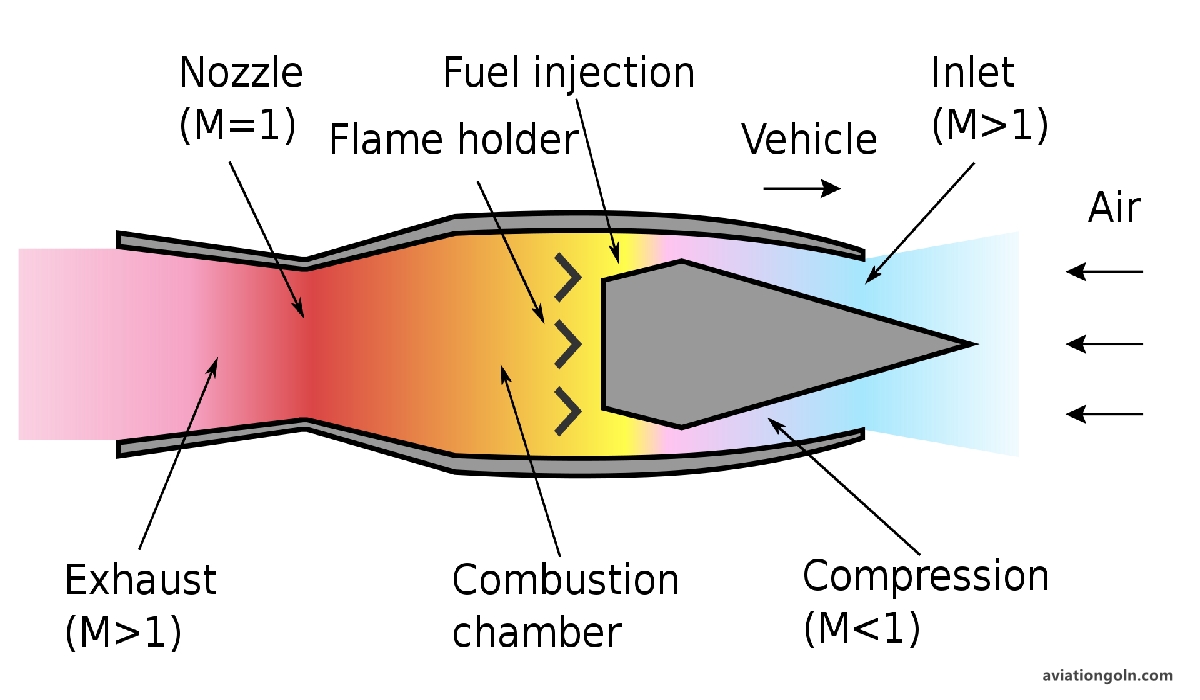
It works on the principle of ram pressure. When an aircraft is moving at a high enough speed, the intake isn’t just a hole—it’s a compression device. The intake geometry is designed to capture incoming supersonic air and force it through a series of internal shockwaves. As that air moves through the duct, those shockwaves act like a physical barrier, slamming into the air molecules and decelerating them from supersonic to subsonic speeds. This creates a massive spike in pressure and temperature.
Once the air reaches that high-pressure state, we inject fuel. It ignites, expands violently, and shoots out of the nozzle to produce thrust. It’s a beautiful, passive system, but it has a massive caveat: it cannot generate static thrust. You need another system to get you up to a “transition speed” (usually around Mach 2) before the ramjet can even take a breath. It is a cruise engine, not a take-off engine.
The Scramjet: Mastering the Chaos of Supersonic Combustion
If the ramjet is a blunt instrument, the Scramjet (Supersonic Combustion Ramjet) is a scalpel wielded by a madman.
The fundamental limitation of a standard ramjet is that the air must be slowed down to subsonic speeds before it reaches the combustion chamber. At speeds above Mach 6, slowing that air down creates so much drag and thermal energy that the engine literally tries to melt itself from the inside out.
The scramjet fixes this by allowing the airflow to remain supersonic through the entire engine. This is an engineering nightmare. We are effectively trying to inject fuel and ignite it in a stream of air that is moving at several thousand miles per hour. We have only milliseconds to achieve complete mixing and combustion before that air exits the nozzle.
In my experience, flame stabilization is the “holy grail” here. If your fuel injection pattern isn’t perfectly calibrated to the shockwave structure, the combustion process becomes unstable. This leads to what we call an “unstart”—where the shockwave is pushed forward out of the intake, causing an immediate loss of thrust and a violent surge of pressure that can literally rip an engine cowling off. Designing a scramjet intake isn’t just engineering; it’s a high-stakes game of fluid dynamics chess.
The Thermal Management Crisis
When you start talking about Mach 5, 8, or 10, the conversation inevitably turns to heat. At these speeds, friction is not just a nuisance; it is a structural threat. The stagnation temperature—the temperature reached when the air is brought to a dead stop at the nose of the vehicle—can easily exceed 2,000°C.
Standard aerospace-grade titanium and nickel-based superalloys (like Inconel) start to lose their structural integrity long before that. This is why we are currently obsessed with two things:
Ceramic Matrix Composites (CMCs): These are the future. They can handle incredible temperatures without the brittleness of traditional ceramics or the weight of dense metals.
Regenerative Cooling: This is one of my favorite engineering hacks. Since we are already carrying fuel, we use it as a coolant. We circulate the fuel through the engine walls before it gets to the injector. The engine heats the fuel up (which actually helps the combustion process), and in return, the fuel keeps the engine walls from turning into liquid. It’s a closed-loop thermal dance that is essential for long-duration hypersonic flight.
The “Combined Cycle” Quest
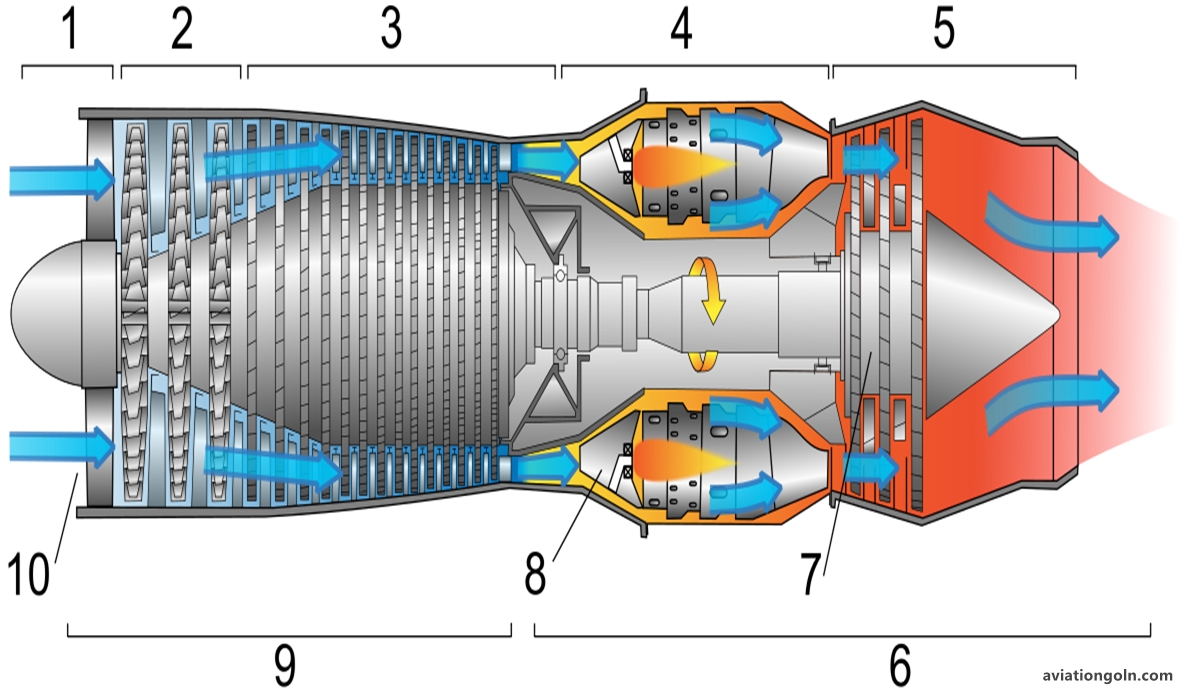
So, how do we actually build a plane that uses this? We can’t just put a scramjet on a runway. We’ve reached a consensus in the aerospace community that the answer is a Turbine-Based Combined Cycle (TBCC).
The vision is a single propulsion system that does everything. For takeoff and subsonic flight, you use a conventional turbojet. As you approach Mach 2, you transition to a ramjet mode. Finally, as you hit hypersonic speeds, you transition into scramjet combustion.
The integration of these three modes into a single intake duct is, quite frankly, the hardest engineering problem I have ever encountered. The duct must change its geometry—literally moving its own walls and ramps while flying—to adjust the shockwave positioning for each flight regime. It’s heavy, it’s complex, and it requires a flight control system that is lightning-fast. But it is the only way to avoid the “two-engine” problem of carrying extra dead weight.
Lessons from the Milestones
We haven’t just been dreaming about this; we’ve been testing it.
The NASA X-43: This was our “Kitty Hawk” moment. It proved that we could maintain stable, powered scramjet flight at Mach 9.6. It wasn’t just about the speed; it was about proving the math behind supersonic combustion was correct.
The Boeing X-51 WaveRider: This was the next step. It pushed the limits of how long we could keep a scramjet running. It taught us invaluable lessons about material fatigue and the reality of flight-testing in the high-altitude, low-density atmosphere where these engines live.
Why This Matters for the Future
Some might ask why we bother with the complexity of scramjets when rockets work fine for space travel. The answer is mass fraction. A rocket has to carry all its oxygen, which makes it incredibly heavy and limits its payload. An air-breathing hypersonic vehicle uses the atmosphere to do the heavy lifting. This drastically reduces the weight, which opens up doors for rapid global transport, more efficient satellite launches, and intelligence, surveillance, and reconnaissance (ISR) platforms that can reach anywhere on Earth in an hour.
The path forward is going to be driven by material science and AI-driven control systems. We are essentially building airplanes that have to react to their environment in microseconds, not milliseconds. It is a brutal field, and it’s not for the faint of heart, but as an engineer, I can tell you there is nothing quite as rewarding as watching a successful flight test where the engine intake stays lit, the cooling cycle holds, and for a few beautiful moments, we reach a speed that was once thought to be impossible.
We are not just moving through the air anymore. We are learning to coexist with a high-energy environment, and that is where the next century of aviation will be written.